Time Value of Money: Why Money Today Is Worth More Than Tomorrow
Why a rupee today is worth more than a rupee tomorrow: future and present value formulas, simple vs compound interest, and worked examples.
“A rupee today is worth more than a rupee tomorrow—unless tomorrow brings two.”
— Every wise investor ever
Welcome to the magical world of Time Value of Money (TVM) — the principle that your money has superpowers when it has time on its side. In this post, we’ll decode the core idea behind TVM with formulas, pictures, and just enough sarcasm to keep your wallet entertained.
💸 What is Time Value of Money?
The Time Value of Money is the idea that money today is worth more than the same amount in the future.
Why? Because today’s money can be invested, saved, or used to buy one more coffee before inflation turns it into a luxury item.
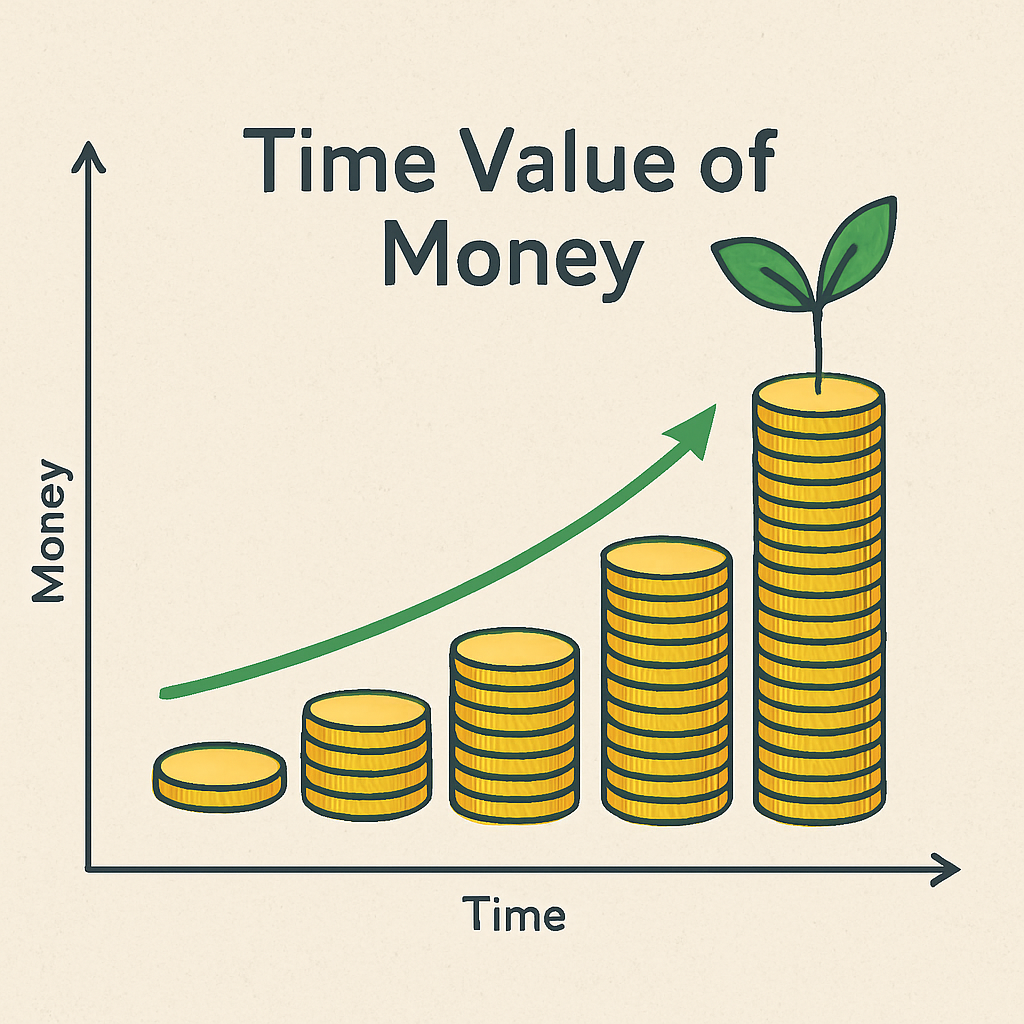 Money, like plants and regret, grows over time.
💸 The Basic TVM Formula
\[FV = PV \times (1 + r)^n\]FV= Future ValuePV= Present Valuer= Interest rate per periodn= Number of periods
\[FV = 1000 \times (1 + 0.10)^2 = ₹1,210\]Example: If you invest ₹1,000 at 10% for 2 years:
Try it: Future Value Calculator — run your own numbers, with regular deposits, any compounding frequency and inflation.
🧮 Compound vs. Simple Interest
- Simple Interest: Only earns on the original principal.
- Compound Interest: Earns on principal + accumulated interest.
 Compound interest is like a snowball rolling downhill… only uphill on your wealth curve.
🔁 Present Value (PV): Going Back in Time
TVM isn’t just about future value. Sometimes, we want to know what future money is worth today.
\[PV = \frac{FV}{(1 + r)^n}\]If someone offers you ₹1,000 a year from now at 10% interest, the present value is:
\[PV = \frac{1000}{(1.10)^1} = ₹909.09\]📈 Visualizing TVM
Compound Growth Over Time
graph TD
    A[Year 0: ₹1000] --> B[Year 1: ₹1100]
    B --> C[Year 2: ₹1210]
    C --> D[Year 3: ₹1331]
    D --> E[Year 4: ₹1464.10]
This is your money working overtime — and it never asks for a raise.
💬 Real-Life Scenarios
- Lottery wins: Lump sum or annuity? Choose lump sum, invest wisely.
- Loans: Interest eats into future payments. Paying early saves money.
- Savings: Starting early = compounding magic.
Try it: Loan / EMI Calculator — see the total interest on a loan and how much extra payments save.
📌 Key Takeaways
- Money now > same money later.
- Compounding is your financial BFF.
- Delay gratification… but not your investments.
📚 Further Reading
Stay invested, stay curious. 💰
PS: If this made you reconsider that daily coffee splurge, my work here is done.